Introduction: Why Candidacy Matters More Than the Procedure
Hair transplantation has evolved into a highly refined medical and artistic procedure capable of producing natural, long-lasting results. However, one of the most important truths in hair restoration is often overlooked: not everyone experiencing hair loss is automatically a good candidate for surgery. The success of a hair transplant depends less on the technique itself and more on whether the individual’s hair characteristics, medical history and long-term hair loss pattern align with surgical possibilities.
From a specialist’s perspective, patient selection is the foundation of ethical and effective hair restoration. A well-chosen candidate can achieve life-changing results, while an unsuitable candidate may experience disappointment even if the surgery is technically flawless. Understanding candidacy is therefore essential before considering graft counts, density goals or surgical dates.
The Core Principle: Hair Transplantation Is Redistribution, Not Creation
A hair transplant does not create new hair follicles. Instead, it redistributes existing follicles from a donor area—typically the back and sides of the scalp—to areas affected by thinning or baldness. This means that donor supply is finite. Every graft moved today reduces the available reserve for tomorrow.
An ideal candidate is someone whose donor region is strong enough to provide lasting coverage while still leaving sufficient reserves for future needs. This balance is the cornerstone of sustainable hair restoration planning.
Understanding the Donor Area
The donor area is the most critical factor in determining candidacy. Hair in this region is genetically resistant to the hormonal influences that cause pattern hair loss. Surgeons evaluate several donor characteristics:
-
Density: The number of follicles per square centimeter.
-
Hair Caliber: Thicker strands provide better visual coverage.
-
Color Contrast: Lower contrast between hair and scalp improves the illusion of density.
-
Curl or Wave: Curly or wavy hair often covers more surface area.
-
Scalp Elasticity: Influences harvesting flexibility.
A strong donor area does not automatically guarantee suitability, but a weak donor area significantly limits possibilities.
Age and Timing Considerations
Age plays an important role in determining readiness for surgery. Younger individuals may be eager to restore their appearance quickly, but early intervention without understanding future hair loss progression can lead to unnatural patterns later in life.
Younger Candidates
Individuals in their early twenties often have unpredictable hair loss trajectories. Surgeons typically exercise caution and may recommend medical therapies or monitoring before committing to surgery.
Mature Candidates
Those in their thirties or forties often present more stable patterns, allowing for better long-term planning. Stability does not eliminate future thinning, but it provides a clearer roadmap for graft allocation.
Hair Loss Stability
One of the most important indicators of candidacy is whether the individual’s hair loss has stabilised. Rapid or aggressive thinning can undermine surgical results because transplanted hair remains permanent while surrounding native hair continues to recede.
Stability is assessed through:
-
Family history patterns
-
Rate of recent shedding
-
Photographic comparisons over time
-
Response to medical treatments
A stable pattern allows surgeons to design a hairline lowering or crown restoration that will remain natural as the individual ages.
Type and Extent of Hair Loss
Hair transplantation is most effective for pattern hair loss, where follicles in specific areas shrink due to genetic and hormonal influences. Other forms of hair loss require different approaches.
Suitable Types
-
Male and female pattern hair loss
-
Traction-related thinning (once the cause is removed)
-
Some cases of scarring alopecia with stable conditions
Less Suitable Types
-
Diffuse unpatterned thinning across the entire scalp
-
Active autoimmune hair loss conditions
-
Temporary shedding caused by illness or medication
Accurate diagnosis ensures that surgery addresses a permanent issue rather than a temporary cycle.
General Health and Medical Factors
A candidate’s overall health influences healing, graft survival and long-term outcomes. Hair transplantation is a minimally invasive procedure, yet it still requires good physiological resilience.
Important considerations include:
-
Controlled blood pressure and diabetes
-
Absence of active infections or scalp diseases
-
No contraindicated medications
-
Adequate immune response for healing
A thorough medical review is standard practice before proceeding.
Expectations and Psychological Readiness
The psychological aspect of candidacy is often underestimated. Hair restoration improves appearance, but it does not transform identity or solve unrelated emotional challenges. Ideal candidates have realistic expectations and understand the limitations of density and coverage.
Key traits of psychologically suitable candidates include:
-
Patience with the growth timeline
-
Acceptance of gradual improvement
-
Understanding that perfection is unrealistic
-
Willingness to follow post-operative care guidelines
Unrealistic expectations can lead to dissatisfaction even with technically successful outcomes.
Hair Characteristics That Influence Results
Not all hair behaves the same way once transplanted. Natural characteristics play a major role in visual density and aesthetic success.
-
Thick Hair: Provides stronger coverage with fewer grafts.
-
Fine Hair: May require more grafts to achieve the same visual effect.
-
Curly Hair: Enhances volume and camouflage.
-
Straight Hair: Offers sleek appearance but less coverage per strand.
-
Light vs. Dark Contrast: Lower contrast between scalp and hair colour tends to look fuller.
These factors do not determine eligibility but influence planning and expectations.
Gender Differences in Candidacy
Men and women experience hair loss differently, and candidacy assessments reflect these variations.
Men
Male pattern hair loss often follows predictable patterns, making surgical planning more straightforward. Donor areas are typically strong, which increases candidacy rates.
Women
Women often present diffuse thinning rather than distinct bald zones. When donor density is sufficient and thinning is localised, transplantation can be effective, but careful assessment is essential.
The Role of Medical Maintenance
Even ideal candidates benefit from medical therapies that stabilise ongoing loss. Combining surgery with supportive treatments can extend the longevity of results. While not mandatory for everyone, maintenance strategies help protect surrounding native hair.
Lifestyle and Commitment
Successful outcomes depend not only on the surgery but also on the individual’s willingness to maintain scalp health and follow aftercare instructions. Candidates who commit to healthy lifestyle habits, proper nutrition and regular follow-up visits tend to achieve more consistent long-term results.
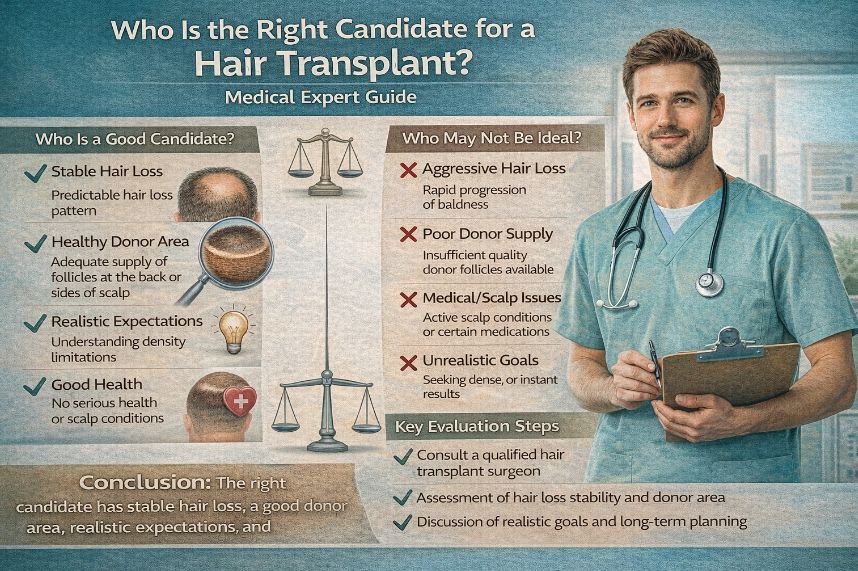
When Someone May Not Be a Good Candidate
There are situations where postponing or avoiding surgery is advisable:
-
Insufficient donor density
-
Active scalp disorders
-
Unrealistic expectations
-
Rapidly progressing hair loss
-
Medical conditions that impair healing
In such cases, non-surgical treatments or lifestyle adjustments may be recommended first.
The Importance of Long-Term Planning
Hair loss is progressive, and candidacy evaluation must consider the future. Ethical surgeons design treatment plans that anticipate decades of change rather than focusing solely on immediate cosmetic goals. Preserving donor reserves ensures flexibility for potential future procedures.
Technology and Modern Assessment Tools
Advances in imaging, digital scalp analysis and follicle mapping have improved candidacy evaluations. These tools allow surgeons to predict density outcomes more accurately and design personalised treatment strategies.
Final Assessment: Balance, Biology and Expectations
The right candidate for a hair transplant is not defined by age alone, nor by the amount of visible thinning. True suitability emerges from a combination of biological strength, medical stability, realistic expectations and long-term planning. When these elements align, hair transplantation can deliver natural, enduring improvements that enhance confidence and appearance.
Ultimately, candidacy is about balance—between donor supply and recipient needs, between present desires and future patterns, and between technical possibilities and psychological readiness. Individuals who approach the decision with patience and informed understanding are far more likely to achieve satisfying and sustainable results.